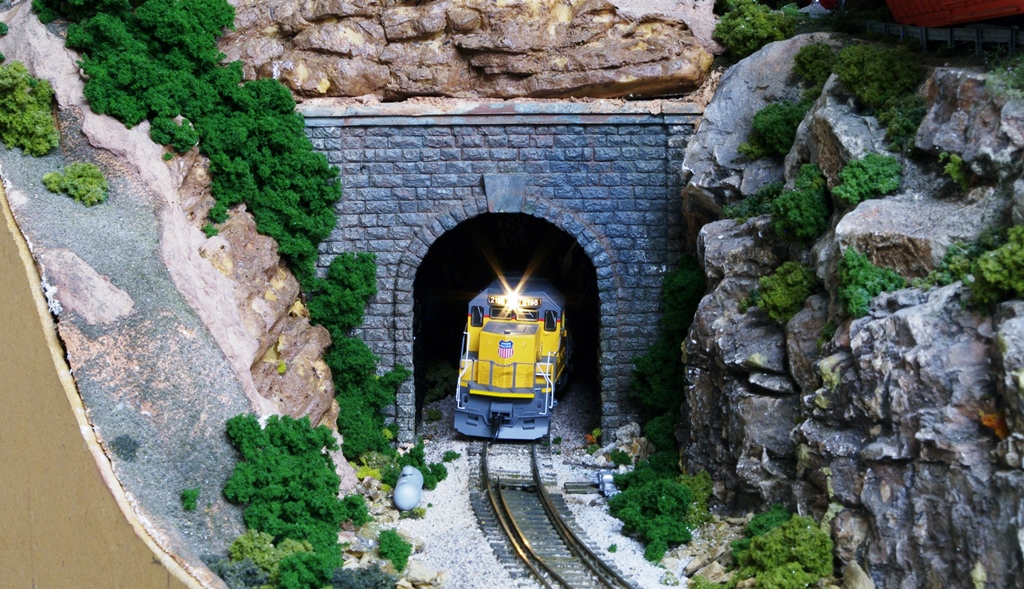
Sunday, September 17, 2017

Taking A Close Look At A Bachmann CP SD40-2

Many modelers have improved opinions of Bachmann products over the past 15 or 20 years, certainly since their Spectrum range, and more so in the past 10 years or so with improved paint work and mechanical and electrical upgrades to their standard line. I've been a fan of their RS-3, S-2/4, and GP7/9 for quite a while. Recently I got a CN SD40-2 and was impressed with its potential. Just the other week, I went ahead and ordered a CP version.

The first two photos are straight out of the box, with just a quick test run to be sure it works:

The paint is smoothly applied and opaque. The lettering is very clear and opaque.

The paint scheme on this loco, according to this site, is Action Red, 5" nose/cab front stripes, small multimark. However, the site isn't clear on exactly which units got this scheme. After 5718 in 1975, 8-inch nose stripes were used, with a small multimark. 5937 would have been delivered in a later scheme, with 8-inch nose stripes and a large multimark. Based on the info I see, I can't rule out some units being repainted in the 5-inch nose and cab stripe scheme.

I popped the body off and hit the chassis and air intakes on the body with grimy black. Looking at the chassis, I saw that the DCC version for this model is the full factory PC board. This does not support most NMRA speed control CVs and comes with a factory-default compulsory speed curve and momentum setting. This makes it impossible to match speed curves and consist the loco with other units. The best bet is to replace it with an NCE BACH-DSL decoder, which is designed to be a drop-in replacement for Bachmann DCC on board decoders.

Here's the loco put back together temporarily with the air intakes now painted black.

Another thing you can see here is that, although the site I linked above says the units with the small multimark had a red area above the height of the multimark on the rear of the long hood, the long hood end here is black and white all the way to the top. Again, I can't rule out that some units may have been painted this way.

Here's the Bachmann unit set next to an Athearn bluebox CP snoot behind it. The snoot has had some roof weathering done. The overall level of detail and proportions look very close.

Here's the bluebox snoot by itself, currently on a dummy chassis. Both the Athearn and Bachmann models are generic in their detail, and the actual CP units have many variations from these models. I'm using them as layout quality models. Bowser now offers models much closer to Canadian prototypes, and they're an option for people who want more accuracy, though of course at a higher price.

On my two bluebox units, I added Detail Associates Chessie-style pilots, which are close to the CP prototype.

The bluebox unit also has the black and white area extending to the top of the hood with the small multimark. Apparently the reflective dots seen on this unit weren't consistently applied to all units.

It slowly began to dawn on me in recent years that, although CP power was common on lines like Guilford's freight main, the former D&H, and the Conrail/NS Southern Tier, the SD40-2s ranged all over former Soo and Milwaukee territory, as well as on NS and Conrail trackage rights in many areas. Good units to have for my general interests.

This multimark CP scheme is out of production at Bachmann, but if you look, you can find them. They still offer later CP schemes. It's worth doing a thorough search for the best price on Bachmann locos, but I get the impression that Bachmann has increased its prices recently and is imposing greater price discipline on retailers. The SD40-2, if you can find it at prices between $50 and $75, is a very good value, especially with a good decoder.

Thursday, September 7, 2017

Looking At My "Purgatory Box"

Fellow blogger and modeler John R has what he calls a "purgatory box", which is a place he puts older models that he obtained in his younger days in the hobby, but for various reasons has taken off the layout, maybe because the trucks and couplers are no longer up to standard, or the paint job is too toylike.

I realized I have something similar, but I never gave it a name. "Purgatory box" is a really good one! In my case, nearly everything in the box is an Athearn bluebox loco. Some of them are from the old wide body days of the 1970s. I spent a lot of time with those, but I haven't run them for a long time. I may well never bring them back.

More recent ones in my "purgatory box" are the newer, narrow-hood GP38-2s and SD40-2s. These were an advance, but I often gave up on them before I could put them into service on a real layout like the one I began in the late 1980s. Pickup was poor due to the old sintered metal wheels and metal strips that carried power to the motor. The coupler mounts needed a lot of rework before you could mount Kadees properly. The metal handrails were a bear to assemble. The huge HO diesel detail aftermarket grew up almost entirely because the Athearn bluebox locos needed so much work.

However, there are some candidates that can be put into service without too much effort. I seem to have gotten pretty far with them, but once better models from Atlas, Kato, and so forth turned up, I took the path of least resistance and put those into service first, just deferring work on the blueboxes. For 20 or more years.

The new Walthers Mainline Soo SD60 changed my priorities. I got more interested in the Soo in the 1990s, when MR ran a number of articles on the railroad, especially the Red Wing project layout in the December 1994 MR. Inspired by the article, which included early instructions on how to convert an Athearn loco to DCC, I got a bluebox Soo GP38-2. I finished detailing it back then, but set it aside. Nearly 25 years later, it's going into service.

It needs some paint touchup. I converted it to DCC:

One thing that confirmed my interest in the Soo Line was that, after CP became the designated operator of the D&H, Soo-CP power would run through onto Guilford, one of my favorite prototypes. The runthrough power was frequently Soo SD60s, as well as Soo and CP SD40-2s. But in the 1990s, there was no easy way to get to a SOO SD60, just the Rail Power Products body and Proto Power West chassis, and a lot of work. The new Walthers model has changed that!

Speaking of Proto Power West, they made "tweaked" Athearn chassis, with extra lead weight, can motors, wire pickup, and tuned mechanics. I have a lot of those in reserve.

The good thing about these was that in the days before DCC and speed matching, you could get an Athearn loco with a PPW chassis to run with an Atlas or Kato loco. The can motors also drew less current.

I have two CP "snoot" bluebox locos that won't be too hard to put into operation. This one, a dummy, will probably get the PPW chassis above, with a DCC decoder:

Here's a Soo SD40-2:

This one already has a bluebox chassis that's had new wheels and a PPW upgrade kit installed. Like a number of these, it was very close to being finished, but it was just a lot easier to get a new Atlas loco or whatever!

A lot of guys who did a lot of work with bluebox locos in the 1970s and 80s built up a surplus of aftermarket parts, expecting things never to change. But the locos that have been available since the 1990s are so much more detailed that a lot of the aftermarket parts will never be used. At least these projects are letting me work my way through my own surplus!

Thursday, August 31, 2017

Operating A "Facade Industry"

Fellow blogger and modeler Ralph V recently put up a post on some of the "facade industries" he uses with his layout. In his case, these are separate dioramas that aren't connected to his layout's baseboard or trackwork that he uses to create a photographic extension of his model railroad. It occurred to me that some modelers have explored this idea in the past, and some have even gone a little farther to add them to operations.

In Ralph's case, he manually carries some cars that he wants to photograph as virtually interchanging with his or other layouts, puts them in the diorama, and photographs them to publish on his blog. Other modelers have taken this a little farther and had a mini or micro layout that, while not connected to the main layout, operates as a "branch". Cars are manually carried as needed between the main layout and the subsidiary micro.

About 10 years ago I was inspired by a micro layout plan at the late Carl Arendt's site, Box Street, designed by the prolific Jack Trollope:

I realized I had enough scrap items laying around from my main layout construction that I could build exactly that plan. The was the preliminary result:

At first I had fun taking it outside and photographing it in natural light, but it was still a hassle to carry it in and out with rolling stock, set it up. plug it in with an extension cord, run it, take it down, etc.

But after a while, I decided to mount it on shelf brackets in a storage room next to my layout room:

Eventually I set it up as a two-station "branch" of my main layoyut on JMRI. The interchange from my main layout is at West Egg. A "route" in JMRI called Hand Carry hosts a "train" called Manual Carry that instructs the 0-5-0 transfer run which cars to move from the Box Street layout to West Egg and vice versa:

A separate JMRI job creates a switchlist for the industries on the Box Street layout (called Paper Box on the LF&NW -- the main industry is a paper mill). One advantage is that it gives me extra spots for car types like wood chip and pulpwood cars that I don't have enough spots for on the main layout.

This is still on DC, not DCC, so I can use locos that I haven't yet converted. However, I've made enough progress on conversions that I'm now thinking about running the DCC bus through the wall to this layout and making it convertible from DC to DCC via a DPDT switch. You can see the Bachmann train-set DC controller that it now uses. A DCC controller will be better for regular operation, but I can still switch to DC for testing new locos or occasionally running unconverted ones.

Then, maybe extending it along the wall. . . I need more spots!

Friday, August 25, 2017

Speed Matching

One of the good reasons for any modeler to go into DCC, even if they don't run with multiple operators, is the ability to speed match locomotives. In the old DC days, it really wasn't a good idea to run Athearn and Atlas locos together in MU. More recent higher-quality Bachmann and Walthers locos provide the same sort of problems. However, speed matching with DCC is fairly easy.

A lot of guys on YouTube, and MRVP as well, tend to make things harder than they need to be. Some say you need a scale speedometer to match speeds, and others say you need to fiddle with BEMF CVs. This may be necessary in some cases, but I've found that 90% of diesels can be speed matched simply with 3-point speed curves and adjustment of CV2, the starting voltage. The rules of thumb I've found:

  • Use CV2 to be sure both locos start at the same speed step. You set up a DCC consist with your control station and put both locos on the track, but don't couple them. Start the consist and see if both locos start running at the same time. If one doesn't and the other does, increase CV2 by small increments in the one that doesn't until it starts at the same time as the other loco.
  • Using the same technique of putting both locos in a consist but not coupling them, try running the consist at a faster speed and see if the locos match speeds. You don't need to be exact, just be sure one doesn't catch up to the other right away. If one is faster, adjust CV6, the mid-range voltage, down by increments of 10 or so until the two locos run at visually a close speed.
  • Then try running them coupled, maybe doing some switching work or running a freight with them around the layout. Check especially to see if one isn't pushing the other hard or holding the other back. If this happens, keep adjusting CV6 on either loco until the problem is fixed.
  • Listen for scraping or groaning sounds that might indicate a loco is being dragged or pushed. Adjust CV6 on the faster loco (generally) until this goes away.
  • If one loco has a lot more flywheel dwell time than the other, you can adjust acceleration and deceleration momentum with CV3 and CV4. This keeps one loco from shoving the other just because its flywheel runs longer. Very small changes in the value will work wonders.
  • No two locos are exactly alike. Two locos can run at the same speed at a mid-range speed step, but their acceleration and deceleration can vary from 0 to the middle speed step. If you have the big issues solved, this won't be a big problem.
  • Make notes of what values you put in the CVs!
Here are some examples of multiple-maker locos that I've speed matched.

The first, below, is a new Walthers SD70ACe that I speed matched with a Bachmann SD40-2. The Bachmann SD40-2 is a special case, because it doesn't have flywheels. But when I set CV3 and CV4 to 1 on any non-flywheel Bachmann loco (like older GP40s), it runs just like a flywheel loco. These two locos match speeds very well.

A Bachmann GP40, an Atlas Classic silver GP7, and an Atlas U23B:

A yellowbox Atlas C425 and a Walthers Proto GP30:

A Bachmann GP7 with an Atlas Classic silver GP7. Note that Bachmann DCC on board locos with factory decoders must have their factory decoders replaced (NCE BACH-DSL decoders are specifically meant to do this on many types) to enable speed matching, but when this is done, these locos operate and speed match very well.

An Atlas U23B and an Athearn GP38-2:

Thursday, August 17, 2017

New Walthers Mainline SD60 Review

As I mentioned in a previous post, I decided to order one of the new Walthers Mainline SD60s. Walthers says these have new gearing and truck sideframes from the Life Like/Proto SD60s they're based on. I ordered the DC, DCC-ready version. I like sound, but too much of it, from my point of view anyhow, can drive you up the wall.

I was flying blind on my order from several points of view. Walthers really isn't consistent from marque (i.e., Proto, Mainline, Trainline, etc) to marque, and even from run to run within the marque (e.g., GP60) on DCC adapter socket and lighting features. I had sort of anticipated that these units would have ditch lights equivalent to the new Mainline SD70ACes, but they don't -- they just have a high headlight. Also, unlike some Proto units, although the number boards light, they aren't separately controllable. Here's the chassis showing the light arrangements, just a single LED:

The DCC interface is a 9-pin. Since the headlights are controlled by single LEDs front and rear, a Digitrax DH126 is a good choice. It fits very nicely on the chassis.

Here's the effect with the headlight lit:

Here's a better view of the loco:

With the 2000 series number and yellow frame stripe, these are best used for post-2005 and in local service. From that standpoint, it's a little unfortunate that they don't have ditch lights, although in local service these aren't always used. On my roster, this will run best with Kato SD9043MACs and Atlas Trainman gensets. Both of these have ditch lights, so I can use their ditch lights if the SD60 is trailing. I made a test run in a consist with a genset:

The genset runs a little faster than the SD60, but with speed matching in DCC, this should be easy to adjust. I'm going to put up another post soon on speed matching.

These locos are robust, smooth runners, with very good weight.

Friday, August 11, 2017

Empire Belt Hopper

Fellow blogger and modeler John R and I have exchanged custom decals for our respective model railroads. After considering possible cars to letter and running some ideas by John, I decided on doing a Mehano-IHC quad hopper, upgraded and with paint stripped. John gave me the number series for ribbed cars, and here's the result:

Partly because the car has missing steps, and partly because it's fun, I added a HOME FOR REPAIRS DO NOT LOAD stencil from a Microscale set:

This won't affect how I operate the car, it's just a feature I add to cars now and then.

Once I finished the car, it began to remind me of the various miscellaneous old quad hoppers that turn up frequently on the UP, lettered for CNW, MP, CTRN, and other owners. I'm realizing this would mix in pretty well with other quads on my layout.

Friday, August 4, 2017

New Walthers Mainline SD60s And SD60Ms

I see that the new Walthers SD60s and SD60Ms have arrived. I'm especially interested in the UP versions and will probably get at least one. These were common in California throughout their lives, and after the SP merger, they were even more so.

Both of the UP versions have yellow sill stripes that replaced the red ones starting about 2005. The standard-cab SD60s didn't last all that long ith yellow sill stripes. Here's a red sill stripe one from 2004:

Here's one with a yellow sill stripe in 2015, about the end of its career:

Oddly, the Walthers SD60 model has the lightning stripe scheme, but none of my standard-cab SD60 photos shows this.

The Walthgers SD60M has the late two-window cab. Here are some photos I've taken:

By this time, these locos were pretty much in local service in the Los Angeles area. A lot more of these had the lightning-stripe scheme, but oddly, Walthers has brought these in with the older straight gray band.

Here's a 2012 shot with a loco still mixed in with newer road power:

But here's one of the last I saw, on a Chicago-area mainfest:

This was in late 2015.