Sunday, August 15, 2021

A Data Point For How The Hobby Has Changed

For over 20 years I was a regular customer at Troxel Brothers Models, one of the old established train stores in Los Angeles, until it finally closed in the 1990s. It was a very old school place. One of its features was a box of 8x10 glossies on the counteer. I can't remember what they sold for; I have the impresion that Ed picked them up from people who were closing out their collections, so they were reasonably priced. Going through my own collection, it looks like I picked up hundreds there over that 20-plus year period. They were from the usual well-known names like Otto Perry, RH Kindig, HK Vollrath, and many others.

I kept them in looseleaf binders cast off from varioius employers, in cellophane separators, which have been deteriorating for decades. I finally decided to bite the bullet and scan them. This had three results:

  • Since I use Carbonite to back up my desktop, the scans are now backed up. Nobody could do this with a collection of 8x10s in binders.
  • With the photos scanned, I can do things like post them on Facebook or on my blog, something nobody can do with ordinary 8x10s.
  • The scans are easier to see than the original 8x10s and much easier to file and locate (assuming my naming and filing system is effective).
And considering how many photos are now available from photo sites on the web, via Facebook, or other social media, I don't know if many people even collect 8x10s any more. I certainly haven't, for at least 20 years. There are now simply better ways to get prototype info.

But a new featrure has also emerged. If I post a photo on a Facebook group, knowledgeable people can comment and add information I'd never have if I'd never published the photo. An example is this photo I found at Troxel sometime in the 1970s from an unknown photographer:

Remarks writrten in pencil on the back say it depicts D&RGW 498 on the ground on the Farmington branch in 1966. I posted it in the Rio Grande Modeling and Historical Society Facebook group. A commenter added this photo of the same train, taken by AM Payne on the same date:
The commenter, Guy Fontaine, added:

D&RGW #498 derailed on January 8, 1966 enroute to Farmington. Jim Mayer of Durango, CO. was on train crew. Accident occurred on Farmington Branch 2.3 miles north of Posta, CO. The train had left Alamosa on 12/29/1965. D&RGW Posta MP455, CO Taken by Payne, Andy M. - 1/8/1966

If I hadn't scanned this and posted it on social media, I wouldn't have had a much more complete vignette of the narrow gauge's final decline.

An interesting point is that the standards of decorum and emotional maturity in Facebook railfan and modeling groups is surprisingly much higher than it was on old forums and Yahoo groups. Thus we can have situations like this where people can benefit each other by exchanging worthwhile information without petty jealousies and one-upmanship.

Sunday, August 8, 2021

More N Work

I wound up spending much of the past week doing more work on the Bar Mills N scale Jeffries Point Stave Company. This is a very complex and challenging kit, and after a week, the most I can say is I'm on the home stretch.

Sunday, August 1, 2021

Some N Work

I was installing light kits in some Kato Amfleets and decided to experiment with painting the molded seats in the interiors. I haven't ridden Amfleets in quite some time, and they've been rebuilt since then. The new upholstery is a shade of light gray. I used a brush to paint the interior seats Model Master acrylic reefer gray.
Here is the result with the plexiglass light bar installed in the body and the body reassembled to the chassis, with power applied:
For contrast, here's an Amfleet II with the original plastic interior color:
I've been working on a Bar Mills N Jeffries Point building. This is based on a well-known and much-photographed building on George Sellios's Franklin & South Manchester. Here's a copy I found on the web, not my photo:
This is definitely one of their advanced-level kits. I wound up getting the four walls and roof assembled, with the basic windows and doors added. Then I took a long break. This past week I finished adding the basic exterior trim. There's still. a good way to go with loading platforms, awnings, porches, and steps.

Sunday, July 25, 2021

Bar Mills Honest Joe's Pawn

After I installed the retaining wall to cover up a city street module base several weeks ago, I've begun to think about working the rest of that scene into the area around it, inspired by George Sellios, but with some tweaks of my own. I've started with a Bar Mills Honest Joe's Pawn kit, which is about half finished in the photos below:
It's leaning because I just plunked it down for the photo. I'm a little surprised I was able to get it even this far over the course of a week, with the last step being assembling the four walls. This is not an easy kit, though Bar Mills warns on its site that it's in the advanced category.

Among the things that added to the assembly time were the need to brace all the walls on the inside, paint and weather them while flat, and add the signs and windows. A separate job was to paint, add mortar lines, and weather the partial brick wall, and to brace it and glue it to the rest of the wooden building.

I wasn't real real happy with the instructions for the kit, but a modeler with the skills to build it is probably going to work around a lot of the instructions anyhow.

In addition, I followed my recent policy of adding Woodland Scenics Light Dispersing Film to the inside of all new buildings, as well as retrofitting many existing ones. I really like the even effect it gives, while concealing the fact that there's no interior, as shown below:

So an additional project here will be to add light diffusing film to the Woodland Scenics/DPM buildings on this street, which I originally built about 35 years ago.

Sunday, July 18, 2021

The Rapido CP FA-2

As I get older, it's harder to work with things like small screws, and finding places to put each new purchase gets harder and harder as well. Thus I'm tending to spend more money on locos that are ready to run with DCC and sound, while buying fewer things overall. As part of this policy, I recently got a Rapido CP Rail FA-2. Here's the result.
When I was a lot younger, I spent some time in northern New Hampshire. I was supposed to be in school, but the lucky part was that I got to railfan Canadian Pacific, Canadian National, Boston & Maine, and Central Vermont. I was in walking distance of White River Junction, and for a while, I had a view of the B&M line across the Connecticut River, where CP ran trackage-rights freights down from Newport, VT. Just about any power on the CP in eastern Canada could turn up on these, including the FA-2s. As it now turns out, without meaning to, I've collected enough CP units to run such a train on my layout.

Once I got this unit out of the box, I was struck by the level of extremely fine detail. Even in my best prototype modeler days, I would have been hard pressed to do such neat work, with such a smooth and even paint job.

One tthing that's in fact changed from the prototype modeler era of the hobby in the 1980s and 1990s is that back then, modelers would get a bluebox or comparable model from Atlas or Walthers and then spend quite a bit on detail parts. The cost of these added up quickly. You could easily spend $1-200 on these alone, leaving aside a can motor and other drive train improvements, on a DC loco. I'm starting to realize that a modeler 30 or 40 years ago would spend an amount then comparable to a high-end model with sound and DCC now, but that modeler then would only be starting a big, expensive project he might never complete.

At my stage, I'm delighted to get a ready to run model at a level I never would have thought possible.

Sunday, July 11, 2021

Still More Experiments With Tamiya Panel Line Accent Color

I'm still working my way through using Tamiya Panel Line Accent Clor for model railroad weathering. As I've said, this has been mainly a product for plastic modelers of aircraft and spaceships, and the typical instructions for use I've seen on, the web aren't always practical for railroad models. Inserting it into fine panel lines and using capillary action to spread it, and swabbing away overflows, isn't as practical. Instead, I've taken to just swabbing it over the whole model area with a brush, letting it settle in and dry, and just soaking up obvious runs with a piece of paper towel, but otherwise letting it do its thing.

As one YouTuber said, the dark brown shade seems to work best on orange or yellow cars. It also works best on cars with fine cast detail, like riveted sides and Youngstown doors. The effect is often very subtle. Here's an Athearn EJ&E box:

Its effect was mostly to highlight the frame stiles and edges of the Superior door. (I had already done a light airbrushing of dust around the lower body and trucks.) Since the sides are welded, there wasn't a whole lot of other detail to bring out.

Here's an Accurail Minneapolis & St Louis boxcar with better possibilities for the accent color to work:

Even though the car isn't yellow or orange, the dark brown shade settled in very well in the Youngstown door, along its edges and door tracks, and around the ladders and grabs. Here and there it also darkened some of the flat areas of the sides.

Now we come to one of the best outcomes so far, an Accurail Katy 50-foot box. I have a "before" shot, made some years ago, below. It's fuzzy, but it gets the point across:

And here's the "after" shot:
The paint takes a lot of the shine off the original model, and it settles into the door recesses, along the edges and door tracks, around the rivets, and around the ladders and grabs. One concern I have about factory painted models, especially in light colors, is that the paint can look too uniform. The laws of optics don't scale down. This helps take away that effect.

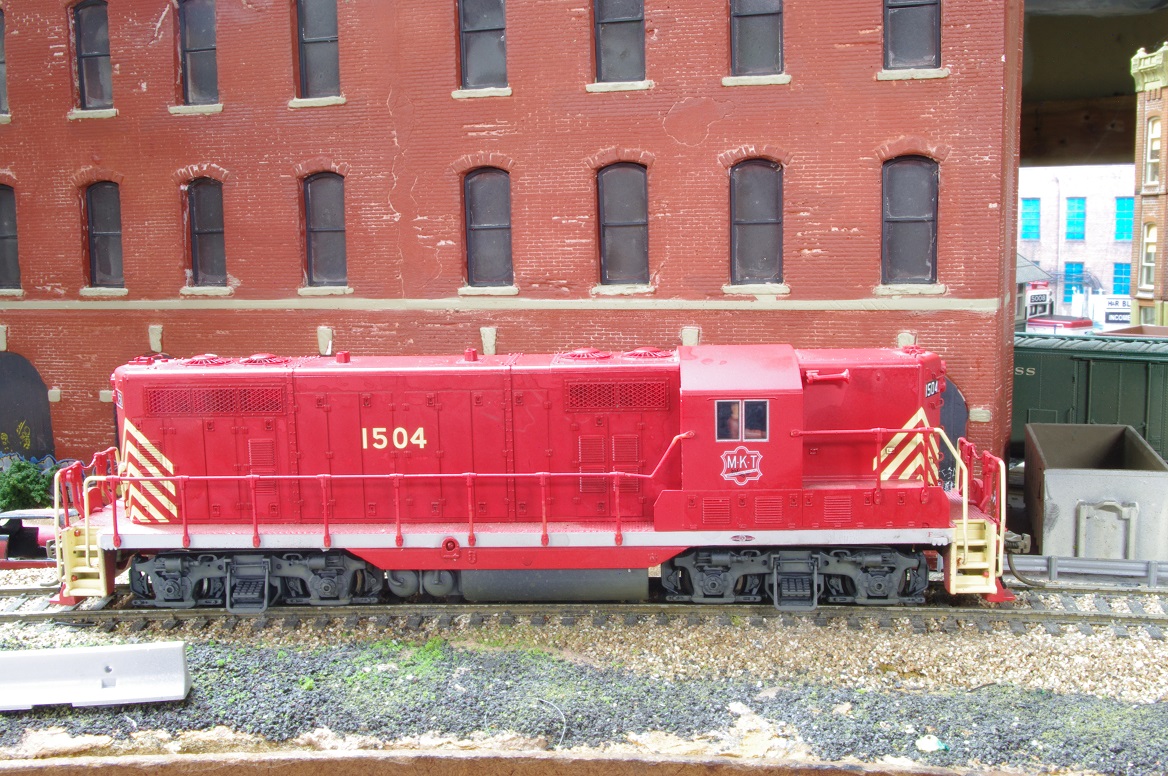
Finally, here's an Atlas Katy GP7 in as-delivered red:

Although the effect is subtle, and it's a little darker in person than in the photo, the accent color did a good job of highlighting the radiator air intakes and the lovers on the hood doors.

There are wide variations in freight car weathering, and there will never be a single magic bullet for modeling it. I find this does an effective job in certain specific cases of light weathering. Other Tamiya shades may also have a slightly different effect. It goes on fairly quickly, dries in about half an hour, and can be used to age a good quantity of cars in a fairly short time.

Sunday, July 4, 2021

More Experiments With Tamiya Panel Line Accent Color

Since my last post, I've looked at more ways to use Tamiya Panel Line Accent Color. In some ways, it's similar to using acryhlic washes with water, but it has less surface tension , and even if it isn't going into fine molded lines, it snuggles up against relief detail closely. For instance, I tried some on an Atlas Austria FP7:
I had previously upgraded it with a Juneco winterization hatch, Shell Scale number board numbers, and Micro Scale kick plates, with some weathering. I applied the Panel Line Accent to the side louvers, sand fills, and handrails. I think it brought the handrails out very well in particular and made them look a little more as if they're separate.

Here's an old AHM vinegar tank csr from the 1960s. With the good luck on the diesel handrails, I decided to try it on the raised details on this model.

I thought it did a very good job with these. The YouTube videos I've watched say the dark brown shade I'm using is best for yellow and orange surfaces, and it certainly worked well here.

Next I had a couple of Chooch stone wall sheets. I was always hesitant to use them, because out of the bubble pack, they seemed too uniform and blah. But I first hit them with random shots of Scalecoat Flat Concrete from a spay can to vary the color a little and then went over the mortar lines with the Panel Line Accent Color.

That was an improvement, but it led me to try more of a full George Sellios treatment. I brushed on diluted Elmer's Glue and then sprinkled the surface with Woodland Scenics fine turf. Then I traced out definite lines with full strength Elmer's Glue and prewssed Woodland Scenics coarse turf into them.
This was just what I needed to push on with more scenery work in this area.

What I'm finding is that the plastic modelers on YouTube, who seem to concentrate on using the product for aircraft and spaceship models, aren't looking at the whole range of uses for it in model railroading. I'm going to try it out next on some mechanical reefers.