Sunday, September 13, 2020

Replacing A Digitrax AR-1

A DCC auto-reverse unit allows operation under DCC to traverse reversing sections in wyes, reverse loops, and similar trackage without the need for manually reversing polarity in situations where rails of opposite polarity come together. They operate by sensing an electrical short in such a situation more quickly than a standard circuit breaker on a booster and reversing the necessary polarity before the circuit breaker sees the shot and trips.

I had a Digitrax AR-1 on a reverse loop for this purpose, but I was never completely satisfied with it. It was hard to set up, The AR-1 uses a " Tunable Trip Current Adjustment Screw" to adjust operation on a particular layout for whatever variables are involved. I found that when I first installed it, I had to fiddle with the screw to get it to operate correctly on my reverse loop.

On top of that, I was never able to get it to work with more than one unit in a locomotive consist. The first loco would pass into the reversing section, and once things were tuned, it would trip the reverser, and the single unit would run through the section. But when a second unit followed the first one in a consist, it would reverse the polarity again and cause a short. I don't know what the problem was, but fiddling with the adjustment screw didn't help.

I resarched the problem as best I could on the web, but i never found anyone talking about the exact situation I had. And from years as a computer tech, I don't have confidence in support lines. So I went looking for a substitute. It seems as though most people are satisfied with, or put up with, the AR-1.

Eventually I settled on the Tam Valley Depot Dual Frog Juicer, which is only slightly more expensive than the AR-1. The basic Frog Juicer works to change polarity on a single switch frog, under the principle outlined above: if it detects a potential short, it reverses polarity before the main circuit breaker can detect it and trip. The Dual Frog Juicer can be used to do this with two rails at once, so it's usable as an auto reverse unit. A jumper is provided that, when closed, will allow it to operate this way.

I swappped out the AR-1 with the Dual Frog Juicer this weekend, and after testing and some supplementary rewiring, it works fine, with single units and multiple units in consist. So I'm very pleased. I've used probably half a dozen Tam Valley products on my layout so far, with aboslutely no problem. No product defects, clear documentation, easy installation. Not every DCC supplier has this record with me.

I can use the AR-1 on a narrow gauge wye that will have only single steam locos operating on it, so I haven't really lost money.

Sunday, September 6, 2020

Bringing The Malabar District On Line

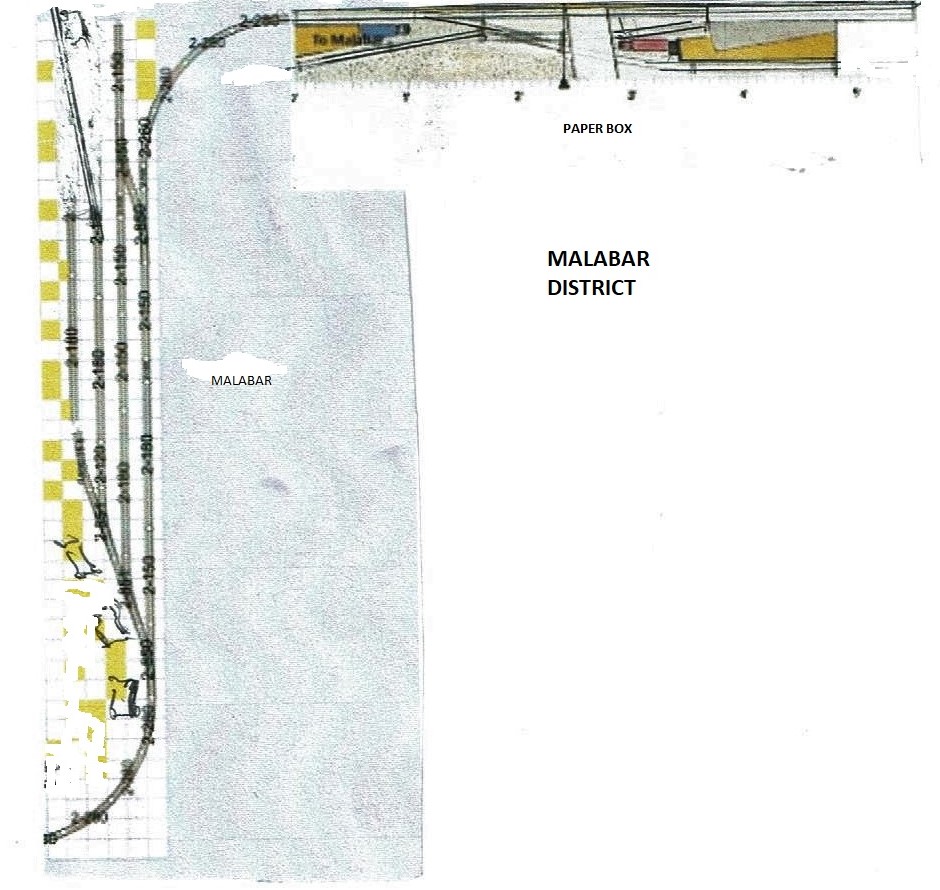
The Malabar District is a pair of micro layouts arranged in an L shape in a storage room next to my main layout.
The section at top right I built, with a few changes, from the late Jack Trollope's Box Street plan. I did this about 15 years ago and ran it as a stand-alone until recently, when I built the shelf at left to connect with it. I incorporated Jack's original drawing into the plan above.

The curve at lower left leads to my main layout in the next room via a tunnel through the wall.

At this point, the district operates mainly with a local that runs from Malabar to Paper Box and back. One thing I discovered in the change from making Jack's Box Street a stand-alone into a part of a larger layout is that I've had to change the way it operates. The original design works from a sector plate at right, where equipment is loaded and the train starts and returns.

BBut considering the way the original plan is oriented, I had o connect it via the straight section at the other end, on the left. This left the sector plate with less to do, since the way freight that runs to Paper Box now enters and leaves from the left. After giving this some thought, I've decided to use the sector plate as a fiddle yard, a place to place and remove cars. Then as I gave this more thought, I realized that the way the funnel to the main layout is built, it can't handle high-wide cars.

So operationally, I've set up the old sector plate as a fiddle yard interchange for high-wide cars onto the Malabar District. I've tweaked the JMRI operating plan to account for this.

Here are some shots of operation with regular trains on the district.

Sunday, August 30, 2020

Quick And Cheap Wheel Car

While I was browsing on eBay, I found a couple of sellers who make wheel car loads (you can probably find them if you go to the site and search for something like "HO wheel car load".) They seem to be reasonably priced, but I began to realize I had the materials on hand to make a wheel car load myself. I replace the plastic wheels in Accurail kits with metal ones, and I've kept so many that I had plenty.

I also looked at prototype photos I've taken of wheel cars. I noticed they don't really look like the loads for sale on eBay. For instance, here's one:

As opposed to the eBay loads, the prototype often has wheels nested between each other in alternate rows, and there's an outside bar on which they rest.

So I gave this some thought. What I did was lay out a piece of wax paper, and then I nested wheelsets in alternate rows, up to a length short of 50 feet. I cemented them together with CA glue. I did it against a steel ruler to keep the string straight. Then when the string was dry, I added some Evergreen styrene strips that I had on hand, two to the outsides and two to the insides behind the inner wheels in the string. Then I added short end pices.

I cleaned off any accumulated CA from the assembly with acetone applied with a cotton swab. Then I sprayed the assembly with Krylon black from a rattle can, followed by Testors Rust enamel from my airbrush, thinned with acetone. Here's the result, mounted on a Walthers Trainline D&RGW work flat:

This took part of a morning and part of an afternoon and cost almost nothing.

Sunday, August 23, 2020

Another SD50

I found another Walthers Mainline SD50, this one DCC ready. I installed a Digitrax DH126MT decoder and replaced th front coupler with a Kadee 146 with long centerset shank. I also touched up the vents with grimy black.
I find I only got one prototype photo of a UP SD50. I believe they were mostly used on unit Powder River coal trains, so they didn't get to Southern California very often. I did catch 5081 at Caliente, CA with the Pizza Man slogan in October 2001.
More SD50s wound up in local service in Mojave after the UP-SP merger. Here is D&RGW 5501 in Mojave, also in 2001:
And SP 5504 on the same day:

Sunday, August 16, 2020

Walthers Mainline D&RGW SD50

This has been out for a while, but I recently got one to complement the SP ex-D&RGW unit on my roster. SD50s and conventional cab SD60s have been favorite locos of mine. I really like the stretch proportions with the Spartan cabs.

The Walthers models are very smooth runners and very heavy. They're reasonably priced, and the cost differential between DC only units and those with sound and DCC is only about $40, which makes the sound version a real bargain.

Some runs have ESU sound decoders. These have built in extra acceleration and deceleration momentum, unlike standard DCC decoders. I find this extra momentum a bit much for my medium size layout, and it also adds complexity for speed matching. As a result, I set CV 3 and CV 4 to 0 when I set the loco up. It also may be necessary to adjust CV 2 to 10 or 20 or so to be sure the loco just starts rolling at speed step 1.

Here are some photos on its maiden run as I adjust it for speed matching in a consist:

Sunday, August 9, 2020

Made It Back To Tehachapi

From March through May of this year, everyone was under a stay-at-home order, so I didn't go railfanning at all. Starting in June, I cautiously began to venture out. This week, I finally got up the gumption to get back to Tehachapi. For me as an LA resident, Tehachapi is a gamble, since it's more gas than Cajon, but it's less predictable. There can be days where there's a work window and nothing's running, or traffic can just be down that day, but you've still spent a tank of gas to get up there and back without seeing much.

It was a fairly good day. When I got to Mojave, a unit BNSF grain empty eastbound was just coming off the hill. It had a "heritage" grain car with the Frisco logo:

The siding at Tehachapi sometimes has interesting work cars spotted on it. I was lucky this time:
The 50-foot flatcar with wooden sides, loaded with random junk, used to be sort of a model railroad cliche. But here we are in 2020 with just that cliche -- and not only that, the cars are freshly painted for D&RGW and MP, with post-2010 conspicuity reflectors.

At the end of the day, I caught a loaded BNSF westbound unit grain train with eight units, three at the front, three midtrain, and two pushing.

That's 35,200 horsepower. When I was young, I thought 15,000 was a lot.

Sunday, August 2, 2020

More Paper Buildings

I was studying more of the collection of photos I've downloaded from the web of George Sellios's F&SM, and several things have struck me. One is that he isn't afraid to work from paper and images printed out from the web. Another is that he isn't afraid to move buildings around, revise them, or kitbash them with other of his buildings.

Here is a project inspired by a similar building at Fillmore n the F&SM. I started with a Gold Medal Flour ghost sign image from the web and glued it to a basic shape made from foamcore.

I added other images and textures from the web to the ends and roof.
However, I left the far side blank, at least for now.
I will probably add details and other features as time goes on, but the whole thing will probably be fanciful a la Sellios, but also subject to change and moving around.

I found a blog by another model railroader who likes paper buildings off the web. He posted a sheet you can download that builds a decrepit leaning shed. I printed the sheet on photo paper and built a model on a basic form made from oamcore.

Both buildings are sited for now in my emerging city project, which will likely owe something to the F&SM.
Where things will go, exactly, is subject to change, of course.