Sunday, November 19, 2023

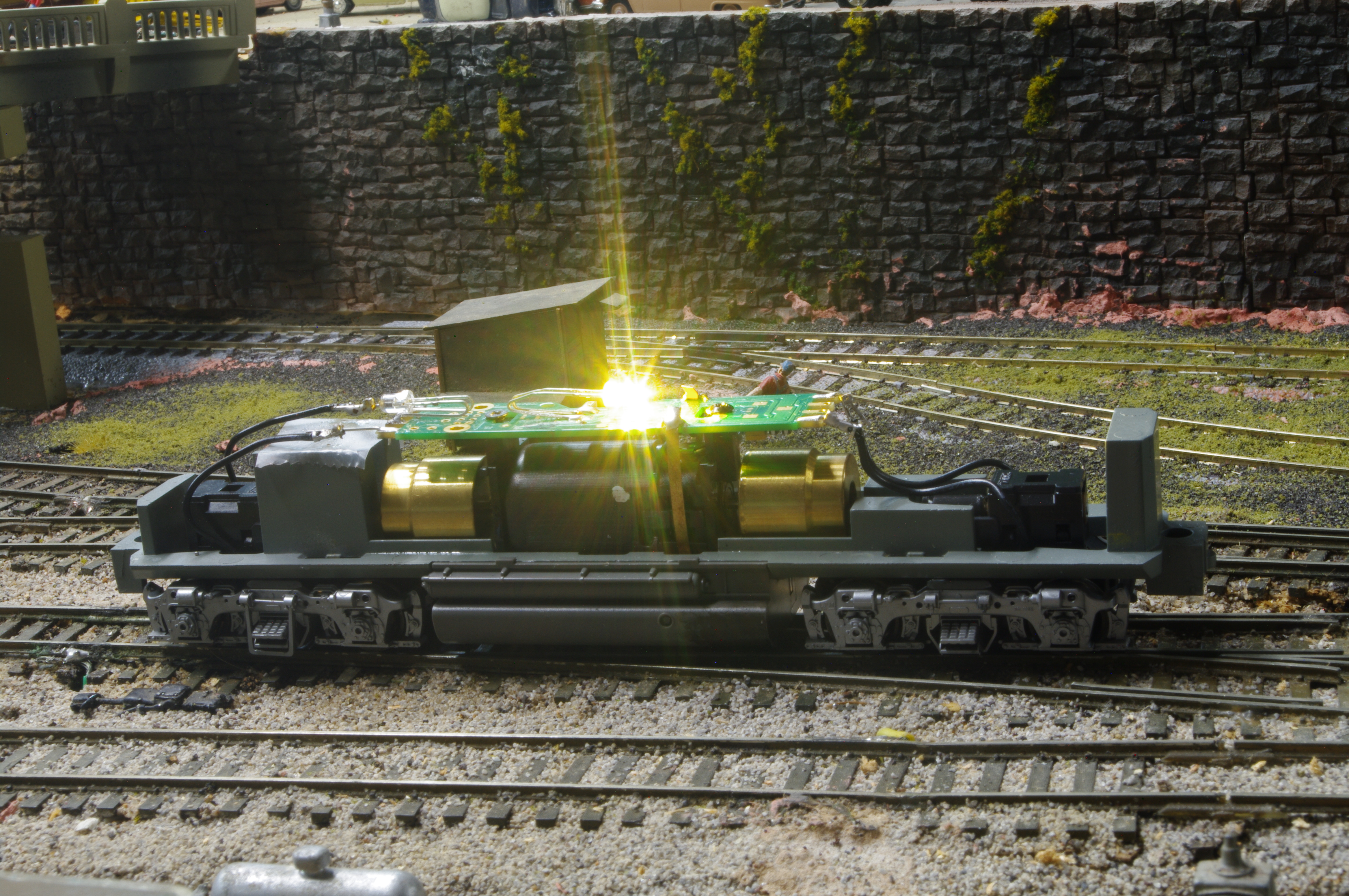
New Decoder In A Bachmann SD40-2

The Bachmann HO DCC-equipped MKT SD40-2 has good paint and decoration, at least for a moderately priced layout-quality model. However, the factory DCC decoder doesn't support the standard CVs for speed matching, so I pulled it and replaced it with a Digitrax DH165A0.

I had initially replaced Bachmann HO factory decoders with the NCE BACH-DSL decoder, which is a drop-in replacement, but I've had frequent problems with all types of NCE decoders where the LED drivers seem to have problems. So far, the DH165A0 seems like a more reliable alternative, although it isn't set up for being attached to the frame using the Bachmann screws. However, Scotch Magic Tape holds it on just fine.

Because the Bachmann factory decoder isn't set up for speed matching, and this version of the model also lacks flywheels, the model straight from the box isn't a good candidate for running in multiple with diesel models by other manufacturers. Replacing the decoder is a fairly low-cost step toward fixing this. (For whatever reason, the Bachmann SD40-2s with sound have flywheels, and the factory sound decoders I think probably also support all the standard CVs.)

I set CV2=15, CV3=2,and CV4=2. The momentum CVs will let it run compatibly with flywheel equipped locos. For whatever reason, the new LEDs that I used with the new Digitrax board are also brighter than the ones with the old decoder, which I like -- always the brighter the headlights, the better.

Sunday, November 12, 2023

Another Atlas Kato GP7

Looking for a bargain that added a mild challenge, I got another Atlas Kato GP7 from the early 1990s on eBay. The price on these can vary from around $60 to over $100, and at the lower end of the range, even with the added price of a DCC decoder, they're less expensive than current equivalents like the Walthers Mainline GP9 or the Bachmann GP7 in DC. Adding the decoder is a little more difficult than just plug-and-play, but it's still an easy intermediate project. Here's New York Central 5690 with Kadees, a Digitrax DH165K0 decoder and LED headlights, and Shell Scale numberboard decals.
The loco apopeared never to have been run when I got it, although it looks like it was outside its box long enough at some point to get some white spray paint droplets on the roof from being nearby when somebody was using a rattle can. I still need to touch some of these up. It also needs to get a winterization hatch.

New York Central 5686-5708 were built in 1952, originally clasa DRS-4H, reclassified ERS-15 in 1966. The class was equipped with dynamic brakes, unlike most other New York Central diesels, including the rest of the NYC GP7s.

Like all Atlas Kato HO diesels, it runs beautifully. Unfortunately, as I get older, it's harder and harder for me to apply the number board decals, and this may be the last Atlas Kato diesel I do.

Sunday, October 29, 2023

Micro Trains Horse Cars

I recently found these Micro Trains horse cars in special at TrainWorld:
I was able to ride old-style passenger trains as a young railfan for about the last dozen years before Amtrak. Horse cars were still around and being used in secondary passenger and mail-and-express trains up to 1971 -- one of my last rides wes on the Santa Fe Super Chief in late 1970, and I saw Santa Fe horse cars in the Chicago coach yard then. If any are still around, they're in museums or work train service.

I also think that by the 1960s, race horses were mostly being flown or towed in highway trailers, so although so-called "horse cars" had stalls for horses, they could be folded away and used in ordinary express service, which was mostly what they were in during the last years of pre-Amtrak passenger service. However, they do turn up in videos of trains in that final era.

I like the Micro Trains models, because they're a different take on baggage and express type cars and will fill in a mail-and-express consist nicely.

Sunday, October 15, 2023

SP Krauss-Maffei Diesel Hydraulics

I've occasionally added brass models to my collection, but I'm happy at this point that there haven't been that many. In general, while it's possible to convert them to DCC, the combination of one-side pickup for steam locos and tenders, or one-side-only pickup for diesel trucks, makes them less suitable for reliable current pickup, and the quality of their mechanisms varies widely among manufacturers. On top of that, we're used to very smooth and quiet operation from later-generation plastic and hybrid models made in Korea, Japan, and China, something brass models have seldom ever achieved.

I have at least one model in my collection that's made me go "hmm", an Overland model of the second, road-switcher style SP Krauss-Maffei diesel hydraulics. I may have gotten this because I thought I remembered seeing these in the San Joaquin Valley, but after studying them further, this was a false memory: according to this site, they were

an order for 15 identical units. They were an experiment in high horsepower diesel hydraulic locomotives that had rather short careers on the SP, being retired by November, 1968.

However, the trip down the San Joaquin Valley where I might have seen them took place in June 1969, so I was a little too late. I probably confused seeing SD45s. Here's a photo of my model, which I believe is one of Overland's last run of their K-M:
So far, it's spent its life in a display cabinet. I took it out for the first time not long ago and tested it on DC. Although earlier Overland K-Ms had the older style zamac gearboxes, this has their later style drive with individual worm and gear drives to individual axles, but even so, it's pretty noisy, much noisier than an equivalent Chinese or Japanese plastic and metal diesel. It also has the disadvantage of right rail pickup from the front truck and left rail pickup from the rear, which means it will be less reliable for contemporary layout running than a mass produced Chinese or Japanese loco.

Most brass models were never made with window glass. This model at least has glass, but while there are headlight lenses in the nose, there's no provision for lighting them. So it looks like beyond adding a decoder, I'd have to add a capacitor plus figure out a way to light the headlights and SP warning lights that wouldn't be a wiring nightmare.

The SP 9010 restoration site also makes additional points about the Overland K-M models: in their short lives of a little over four years, the units underwent a great deal of modification. It looks like they were never quite right, but SP persisted as long as they could to make them run before they gave up. The version in this Overland model is basically the appearance of four final units following a last full shopping they received in 1966-67. These units were 9107, 9113, 9116, and 9120.

The most visible change after this shopping was square shoulders on the radiators that were added to extend the capacity of the cooling system. You can see these on the roof of the model at the mid-point and rear of the long hood. Only 9107, 9113, 9116, and 9120 had these, so Overland's number 9117 on the model is incorrect (as far as I can tell, Overland gave these models random numbers in the K-M renumber series when they were painted at the factory).

However, there were numerous other variations on every unit for features like cab windows, sun visor, horns, lettering, and so forth, so that no two were alike, and no Overland model was ever quite correct for any individual prototype unit. So I'm just on the fence over converting this loco to DCC, especially since if I were to operate it on the layout, it would be subject to general wear and tear, and the model itself is just a little too nice to let that happen. So for now, I think it goes back in the display case.

On the other hand, Piko has announced an HO version of the original, cab-unit style SP K-M diesel hydraulics. I may well go for this, as it eliminates all the problems to trying to convert a brass model for DCC, with sound to boot.

Sunday, September 24, 2023

Digitrax DH165K0 Decoder In A Stewart F3A

The Digitrax DH165K0 decoder is meant for 1980s and 1990s Kato HO locos, including those made as part of the Atlas Kato yellowbox line, the Kato-only GP35s from the 1990s, and locos Kato built for Stewart, including their F units and Baldwin road switchers. Their biggest advantages are contacts that mate directly with the flat brass motor contact strips, as well as wire extensions that match the Kato track power wires from the locomotive trucks.

It isn't quite drop-in, but it's not too much harder than an 8-pin plug and play installation. The biggest complication is the need to solder LEDs to the decoder for lighting, including the need to observe the LED polarity.

Here's a DH165K0 mounted in the chassis of a Stewart F3. The F3 and other F unit models with Kato chassis date originally from 1987, so they are the same vintage as Atlas Kato locomotives, and mechanically and electrically they're very similar.

Although the Stewart F units were strides ahead of what had gone before -- especially the redoubtable Athearn F7 -- later units from Athearn Genesis, Walthers, and Broadway Limited have surpassed them in paint and detail. In particular, the Stewart locos came without grab irons or handrails, and they lacked other common details like lift rings. Modelers had to add separate details from sources like Detail Associates and Details West and supplement the paint with decals from Microscale. This turned out to be quite a task for each unit, and I'm grateful for the newer models that have saved all the extra work.

Stewart also had a one size fits all headlight for units that had either a single headlight in the upper position or an upper light and a lower one in the loco nose door. The chassis casting wouldn't allow installation of a bulb or LED shining through the lower position alone. From the box, the A units had an incandescent bulb shining through a brass tube leading to the upper headlight housing.

In this unit, I replaced the incandescent bulb with a wired LED soldered to the auxiliary F0F pads at the center of the decoder. The LED was a little too big to fit inside the brass tube, but I found that if you simply let the LED sit in the circular opening for the tube in the A unit plastic coupler mount, it will stay there.

The upper and lower headlight lenses on the locos with dual lights are a single clear plastic molding, so that light from the upper location bleeds down into the light in the door. Without a great deal of extra work, this is as good as you're going to get, and while prices on eBay for these units vary widely, the small price differential between, say, a Stewart without a DCC interface and no handrails versus a comparable current-run DC-only Walthers Mainline loco, even with basic detail, makes the Walthers Mainline a better choice.

On the other hand, I coilected a lot of these Stewart locos in the 1990s when they were the only thing available, and I think if you have them, they run very well, and they're worth the DCC upgrade.

Sunday, September 17, 2023

Kato 1990s HO GP35s And The Digitrax DH165K0 Decoder

The Kato HO GP35 was originally released about 1992, and it was reviewed in the September 1992 MR. Kato re-released the model in 2015 with two big updates, draft gear boxes that were compatible with Kadee couplers, and a PC board with an 8-pin DCC socket. The 1992 model, which had more in common with the 1980s and 1990s Atlas Kato HO models, didn't have these features.

However, unlike the Yellowbox Atlas Kato locos, it did have cab interior detail. Although this was rudimentary in comparison with contemporary high-end models, it was an improvement, but it did affect DCC conversions of the 1990s GP35, since the front light bar ran through the cab interior and requires a different style of LED mount on a decoder. The Digitrax DH165K0 is the only decoder on the market that I'm aware of that's specifically designed to accommodate this problem with the 1990s Kato GP35.

The DH165K0 instruction sheet details rthe installation procedure, including how to solder LEDs to the decoder. A finished Kato GP35 chassis with a DH165K0 and LEDs soldered on and set up for bidirectional lighting is shown below:

The decoder has solder pads that allow a forward-facing LED to be mounted in the center of the decoder to interface with the front light bar that runs through the cab and terminates well behind the cab rear wall. The rear-facing LED can be mounted on the rear of the decoder. Some care has to be taken with both to keep them from getting in the way or either light bar, but it's possible to mount directional LEDs without cutting the light bars, unlike with the Atlas Kato HO locos.

Another problem that's partly visible in the photos above is that the cab interior can push the wires leading from the front truck to the decoder out of position when you reattach the shell, which can potentially result in the wires rubbing against the universal shaft that leads to the front truck. This can result in noisy running, so you have to be careful to make sure those wires are out of the way in decoder installation.

A problem with the 1990s Kato GP35 is also that it was meant to use horn-hook couplers, and the pilot and chassis don't quite match the old Kadee #5 style coupler box. They don't match the newer Kadee whisker-style #148 coupler box at all. You're best off using #5 style coupler boxes with the "ears" completely cut off, and then the whole assembly filed or sanded slightly thinner. You can tap the existing hole for the coupler mount in the chassis with a 2-56 tap and mount the box with a #2 machine screw.

I had a small backlog of Kato 1990s GP35s that I'd hesitated to convert to DCC until I discovered how much easier the DH165K0 makes the job. Here are two I've recently done:

You can see the LED-powered headlight especially well on UP 762. I still need to add Shell Scale UP style numberboards on this loco. Both locos are also still waiting for prototypical horns.

Wednesday, September 6, 2023

I've Found A Good Solution For Adding DCC To Atlas Kato HO Locomotives

I became a dedicated collector of Atlas Kato yellowbox HO engines from their first release in 1985. The 1986 RS-1 and the 1990 GP7, with their heavy metal frames, were even better. I was a late adopter of DCC, starting only in 2012, so I'd accumulated a good number of Atlas Kato locos, all of which had been developed before DCC arrived in the mid 1990s. This meant that at some point, I'd have a project on my hands to convert all of them, and none would have anything like an 8-pin socket for an NMRA plug.

At various times I've tried the NCE DA-SR and the Digitrax DH165A0, which are nominally intended for Atlas locos. It's only been very recently that I'd even heard about the Digitrax DH165K0, which is nominally intended for Kato HO locos without 8-pin NMRA sockets. But other than the Atlas Kato yellowbox locos, I think the Kato HO GP35 is the only one that doesn't have an NMRA socket, although the old pre-Bowser Stewart Kato locos are also compatible with the DH165K0.

But I finally tried a Digitrax DH165K0 on an Atlas Kato HO GP7:

There are two big advantages to the DH165K0 over the DH165A0 for Atlas Kato locos. The first is that the contacts for the motor leads are designed specifically for the flat brass strips that reach up to the Kato plastic distribution plate on top of the motorr that carries the contact wires from the trucks and the single incandescent headlight bulb. The second is that the DH165K0 carries wire extensions from the track power nubs at the end of each end of the decoder that correspond to the former brass wires on the Kato plastic contact plate over the motor. Both make the conversion more of a drop-in with less need to strip the track power wires from the trucks or solder new wires to the flat brass motor contacts. Also, the interface between the flat brass strips and the decoder gives you a positive forward and reverse for the install without the need to test the motor polarity.

I've also found you can bend golden white LEDs as shown in the photo above and solder them directly to the headlight contacts on the decoder for bidirectional LED headlights.

With the bidirectional LEDs installed as shown, you need to shorten the light bars for the headlights. You can do this with wire cutters directly on the light bars still in position the body shell. There is no need to flatten or polish the cut ends for the light to pass through to the headlights on the shortened light bars.
In the 1990s I got four Altas Kato Illinois Central GP7s. I renumbered two of them with the old Herald King decals, which I think worked out well. I got four due to family connections with the IC, as my uncle worked variously for the Lackawanna, the Western Pacific, and the Illinois Central, winding up his career as the CEO of IC.