Sunday, April 28, 2024

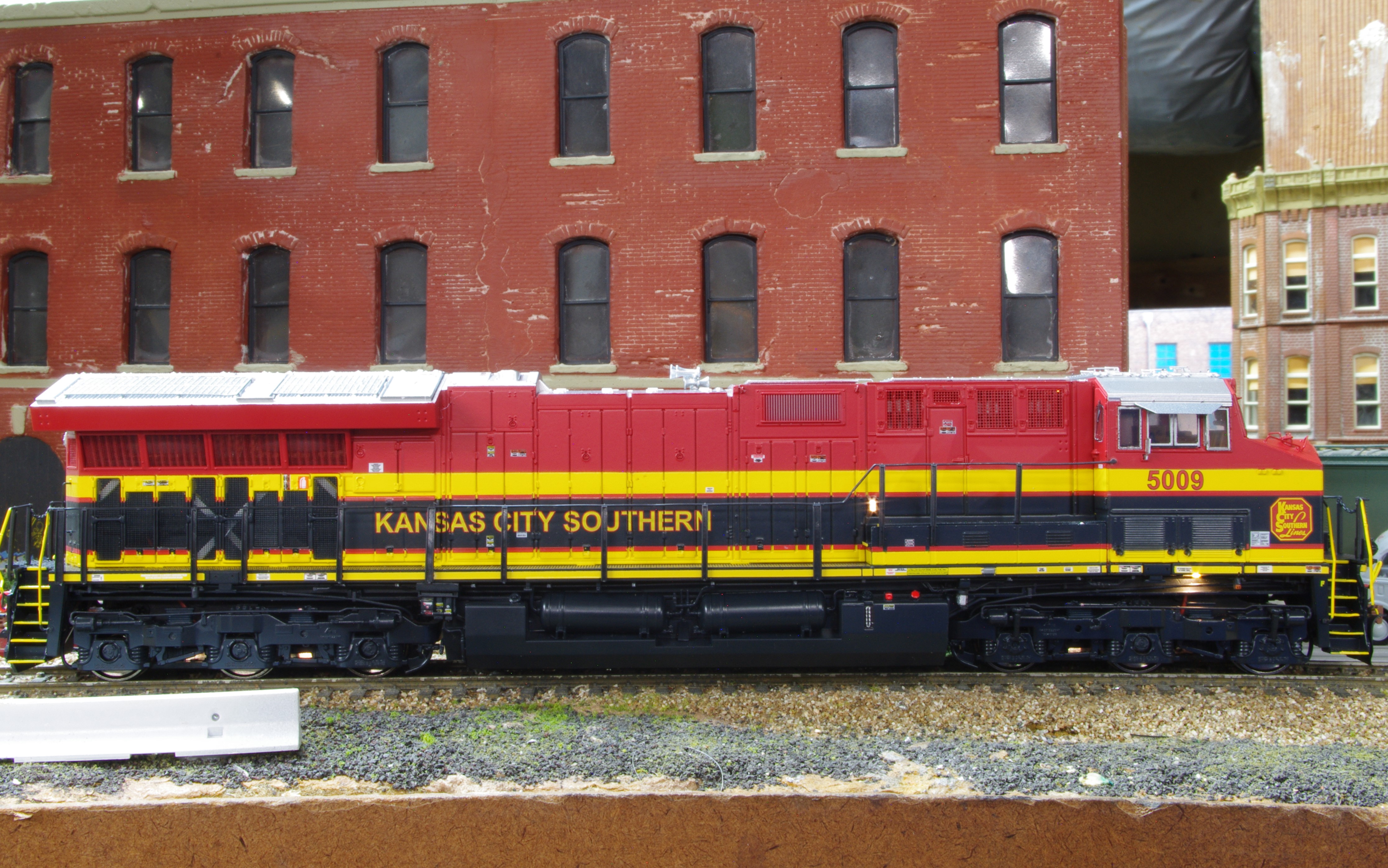
New Piko HO SP Krauss-Maffei

I've been interested in the Piko HO Krauss-Maffei ML4000 diesel hydraulic since they announced it. I talked more about the prototypes in this post last October. I got mine a month or so ago, and I'm still working my way through it.
One first impression is that the lights are satsifyingly bright, unlike some other recent models, but I also discover that the decoder is proprietary Piko, and the function keys are wandering far afield from US suppliers. The headlight is 0, but the oscilating warning light, unlike other suppliers who put it at 5 or 6, is at shift F10. The lighted number boards are F9 (engine startup is F8 like ESU, but it's complicated after that). The markers are press F9 twice.

Apparently Piko, unlike ESU, won't allow you to remap functions to try to make things more consistent. I also discover that I can't change the loco address, which is 3 by default, to 9000 on the main with my NCE ProCab. Piko USA support replied quicky to my e-mail about this and said to use the programming track. This did work. There is no quick start guide for the unique and proprietary DCC-sound system, which US suppliers normally provide.

More recently I've started to test it in MU with a Walthers Proto SP black widow GP9, which the prototype often ran with in MU as single units.

I had no problem setting the two locos up in advanced consisting on my NEC Pro Cab and speed matching them. (I've often found that at the speeds I use to operate, it's sufficient just to adjust CV 2 to get each loco barely to start rolling on speed step 1.) So far, I'm not seeing a problem. Also, the Walthers Proto SP black widow GP9s have empty number boards, which is correct for a loco not in the lead before 1967, while the K-Ms were mostly out of service before that time, and both the K-Ms and GP9s were renumbered in the 1965 SP renumbering, so the paint on the black widow GP9 is exactly right for this role between 1961, when the K-Ms were delivered, and 1965.

However, the biggest problem with the Piko K-M I've seen so far is that the couplers are plastic, possibly McHenrys. Their uncoupling loops are a little low, and my experience with McHenrys is they're too brittle for any serious service. I still need to replace these with Kadees on my model.

So it's a good model with a few imperfections -- an A, but not an A-plus.

Sunday, March 3, 2024

Broadway Limited Chicago Great Western F3s

I ordered a set of Broadway Limited Paragon 4 F3s painted for the Chicago Great Western. I got a full A-B-A set made up of a powered A-dummy B combo and a single powered A. They are numbered 101-A-B-C. This creates a problem if you want to number and control the two cab units separately in DCC. I simply gave 101-A the DCC address 101 and 101-C the DCC address 102. The various lighting features can be controlled individually if you set CV 128=1 to enable Pro Mode Lighting as outlined on page 19 of the BLI Operator's Manual. The oscillating warning light isn't lit in the shot of 101-A below, but the cab light, headlight, and class lights are:
In the photo of 101-C, the oscillating warning light is on, but the cab light and class lights are off:
Unfortunately, the BLI units don't have a ground light feature.

The Chicago Great Western was best known for running F units in A-B-B-B-B-A sets of six. Here's a photo I found on the web with six units in full as-delivered paint:

The F3s were delivered in October 1947 in A-B-A sets. A photo of such a set is below:
The CGW didn't order more B units to fill out the consists until 1949, so that an A-B-A set is definitely correct for the first two years of operation, but A-B-A sets were still used in some situations after six unit consists became the norm. By that time, the extra B units arrived in the later F unit body style with horizontal side vents similar to the F7, so that a consist of six matched F3 units would be unusual.

Unfortunately, Broadway Limited doesn't offer either separate B units or powered B units, but a later-year consist can be filled out with Stewart or Bowser F units in the all-maroon scheme.

Sunday, February 25, 2024

Ground Lights

One development in the past few years has been model locomotives equipped with step lights and especially ground lights. This has been a feature I've wanted to see ever since I first went railfanning. A post on the Model Railroader forum explains what they are:
The lights above the truck under the cab are actually called ground lights. They were controlled by the same switch that controlled the gage lights on the engineer's control stand. The switch was labelled "ground & gage lights" They were of little use for locomotive inspections. They were useful when starting a train in the dark. They enabled the engineer to see the ground to tell when the train started to move.

Before radios became common they allowed the trainmen who had to pass lantern signals to the engineer know that the engineer could see their signals. If the trainman could see the ground light he knew that the engineer could see his lantern.

ScaleTrains has addeds ground lights to its HO releases over the past several years. Here's a Tier 4 GEVO:
Here's a UP GP9B:
Here's a Rapido UP high nose U25B:
Ground and step lights always illuminate on ScaleTrains units when you press F8 for startup. They're controlled with a sepatrate function key on Rapido units.

Sunday, February 11, 2024

T-TRAK Update

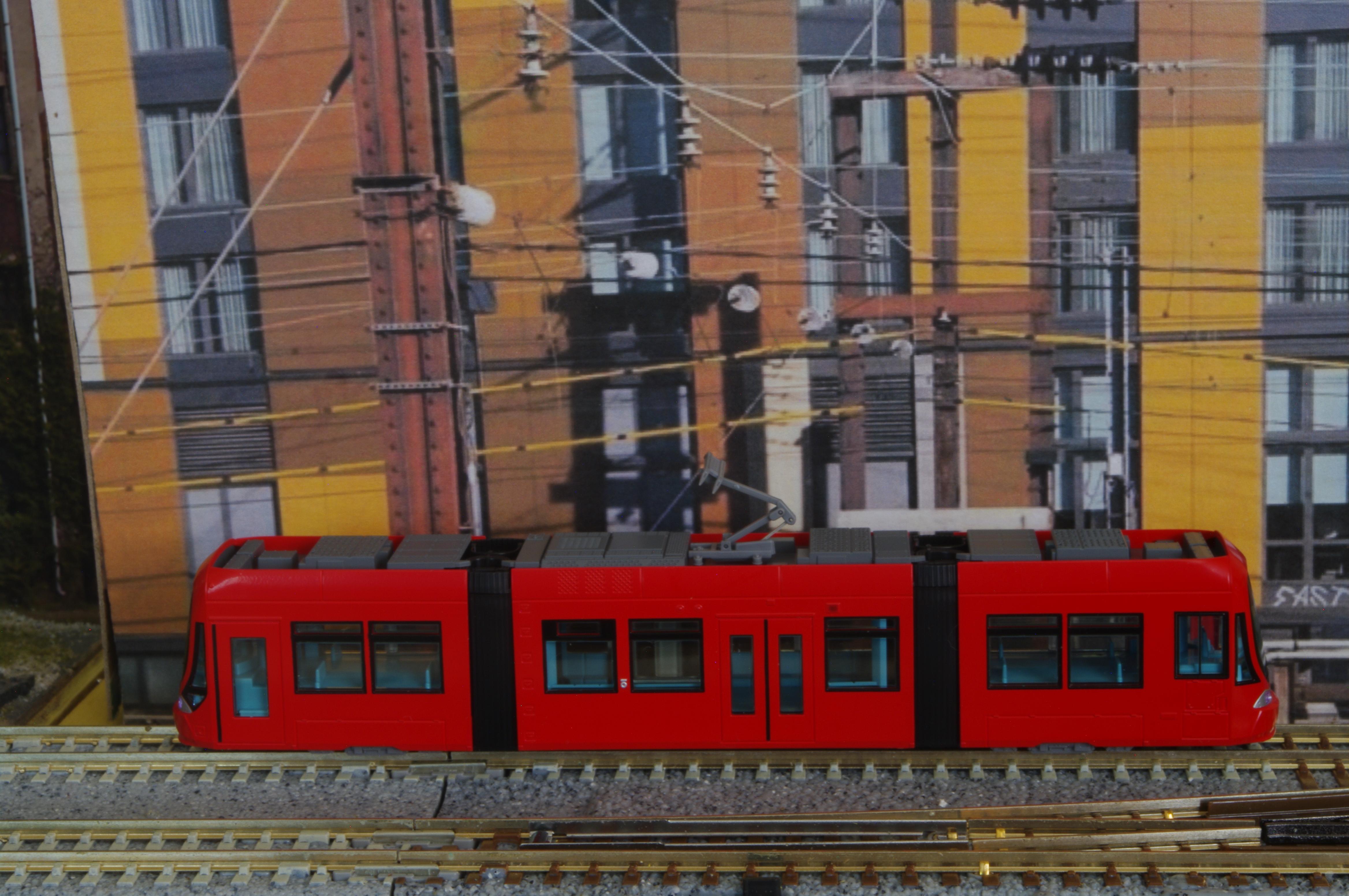
I've been playing with two relatively new Kato products, a "generic" LRV that they market as Mytram, and a 4-5/8" radius curve in their Compact Unitrack line. The Mytram is loosely based on cars in Hiroshima, Japan. The earliest reference I can find to Mytram models is 2021, but they've become popular much more recently. The 4-5/8" radius curves seem to be newer.
As far as I can tell without disassembling the model, the truck under each section is a power truck driven by a coreless motor. There are several obstacles to DCC conversion, starting with the lack of space for a decoder, but continuing with the need for two decoders, one over each power truck, and this leaves out the question of lighting. However, the model will run on address 00 using a Digitrax controller (an NCE will not run a DC model on any address). On DCC, the car emits a slight whine. It's very smooth running on either DCC or DC.

The Mytram will take the Compact Unitrack 4-5/8"curve, and as one photo below shows, it will negotiate an S-curve with no intermediate straight section. This will allow a trolley-style balloon turnback loop within the depth of a single standard T-TRAK module and the width of a double wide.

I've mocked up a trolley-style balloon return loop that conforms to T-TRACK double track standards, so far just on a set of books stacked up to module height at the end of a T-TRAK module. I've ordered a pair of single-wide modules to connect together permanently for one balloon return loop to test the idea further. As it stands, the ability to run a barbell-shaped traction layout via interchangeable modules in a straight row seems to give more flexibility than a small roundy on a single baseboard.

Sunday, January 21, 2024

I Called This One Three Years Ago

Via the Trains.com website,

Last week, the model railway community was surprised to learn of the closure of Hattons Model Railways, a renowned United Kingdom-based model railways manufacturer and distributor. In the ensuing days, questions have arisen regarding the future of M.B. Klein, also known as Model Train Stuff. It was announced in September of 2023 that M.B. Klein had been acquired by Hattons. A representative from Hattons has issued the following statement to Model Railroader regarding the future of Model Train Stuff:

“At this present time, the company is undergoing reorganization and we will share further news as to the outcome of this in due course. Hattons does own M.B. Klein; However, the two companies are operated as separate entities.”

Since the announcement of Hattons closure, the status of Model Train Stuff’s website changed to reflect the current status of the company.

A lot of people were taken by surprise at the Hatton's announcement, as well as M B Klein's closure, but in February of 2021, I posted this: My Bet Is That Modeltrainstuff.com Is Heading The Way Of Caboose Hobbies. I talked about Caboose Hobbies and the increasing problems I had ordering from them before they closed their Denver store in 2016.

I concluded that I was seeing the same symptoms from M B Klein, and it looks like I was right. In the mid-2000s, M B Klein had been a brick-and-mortar train store in downtown Baltimore, but its owner, Ted Klein, saw the opportunity to expand into internet discount sales. M B Klein as Modeltrainstuff.com became a major online retailer, and I was a frequent customer, especially aftter Caboose Hobbies went under. However, Klein died in 2020, and service began to deteriorate soon after.

The staff blamed it on COVID, but I have a feeling the real problem was the loss of Ted Klein. But I'm also intrigued that whoever was the owner after Klein's death sold out to Hatton's just last fall, and only a few months later, Hatton's went under. Was there a problem with Klein's that took Hatton's with it? But as I said in 2021, hobby stores come and hobby stores go.

Sunday, December 3, 2023

Chinese Plastic Palm Trees

Last August I posted about progress with scenery around my junk yard area. I did some thinking about trees that might establish the area is in California, and I watch a YouTube channel, SoCal Scale Models, where in one episode Rick, the host, explained how he orders ready-made Chinese plastic palm trees off Amazon. He shows what he does in this YouTube:

While I generally prefer eBay to Amazon for stuff like that, I went looking on eBay and found this 18-piece set. What set it apart from many other palm tree models, including the ones Rick used, was that they look like a very common local California type, fan palms, that have fan-shaped fronds and a "beard" of old fronds hanging down from the live ones at the top. These arrived quickly at a very reasonable price. I touched them up with paint I had on hand from rattle cans and brushed acrylics to make them look a little less plastic.

Here's a prototype photo of Washingtonia filifera. The size of the "beards" seems to depend on how often the trees are trimmed and how old they are.
And here's a grove of fan palms along the BNSF at a location called Stoil in the San Joaquin Valley. I'll probably use the smaller trees in the set that are closer to N scale on a T-TRAK module.
There are little swaths of white on the bases of my model trees, because I had just planted them with some Hobby Tac that hasn't dried yet.

Sunday, November 26, 2023

Broadway Limited Union Pacific SD40

I recently found a Broadway Limited HO Union Pacific SD40 at a very reasonable price. What impressed me was that in the past, Broadway Limited diesels have tended to be "generic" models with minimal road-specific details other than paint schemes. This model, which is a recent Paragon 4, is a major exception, more comparable to ScaleTrains or Athearn Genesis, with both road name and unit-specific details.
In part, this threw me off. Previous models of UP SD40s, like the Kato 1990s HO version, have taken the easy way out, being based on the UP's first two orders of SD40s from 1966, numbered 3000-3039 and 3048-3082. These were plain vanilla with the exception of strobe lights on the cab roofs of at least some units. But when I got this model out of the box, the first thing that hit me was the trucks, which had a third brake cylinder and clasp brakes, unlike the 1966 locos. The number also bothered me, 3117, which made me think intuitively that this must have been an SD40-2 number.

So I went looking for more info. The Don Strack Utah Rails roster clarified the number: the UP had a third order of SD40s in 1971, just before the switchover to SD40-2s, numbered 3083-3122, and 3117 would be in this series. This third order was completely new to me, and I thought I was pretty familiar with the UP roster.

I went looking for prototype photos on the web, and the 3083-3122 also had trucks with the extra brake cylinder in the center. The one big difference between the prototype photos and the model is that at least one photo shows that 3117 didn't have a plow, at least at the time of the photo. On the other hand, photos do show other units in the series with the large SD40-2 style plow on the model, and 3117 may have had a plow at other times.

Based on the Don Strack page on UP diesel paint schemes, the paint acheme on this model would date it between February 1984, when the UP changed the color of trucks from aluminum to gray, and June 1986, when classification lights were painted over. However, according to Strack, rhe UP had stopped using class lights some time earlier.

BLI Paragon 4 models have capacitors to improve the sound decoders' performance on dirty track. This loco continued engine sound and lights for about one second after I turned off the DCC track power. The headlights, class lights, number board lights, and cab lights are all separately controllable via function keys on the DCC control station. UPDATE: To control the individual features, you need to set CV 128=1 for "pro mode lighting". Unlike the highest-end recent models, the BLI SD40 doesn't have step lights or ground lights.

My biggest problem with the model was couplers. Both ends of the model come with long-shank Kadee compatible couplers in a proprietary coupler box. While I like long shank couplers when they're used with a plow, on this model, as with the UP prototype, only the front has a plow, so I wanted to replace the rear coupler with a standard-length Kadee 148. The openings for the couplers in the pilot plates on the model will fit a 148-size box, but the mount for the proprietary BLI coupler box is too short for a full 148-size Kadee box. Thus I had to spend a fair amount of time trimming the 148 box to fit, but once I had removed material from both the front and rear of the 148 box, I waa able to install the new assembly with the BLI screw.