Tuesday, December 27, 2016

Rewiring Project Proceeding

The video below documents the biggest reason I undertook this rewiring project: I wanted to add more signal detectors, but this part of the layout was moved from an earlier location and has several layers of wiring kludges. Eventually, about three years ago, I more or less realized I needed to tear all this out and start over. Around the same time, I started converting to DCC, but things like basic loco decoder installation (and climbing that learning curve) took priority.

Finally a few months ago I got the confidence to rewire this section of the layout. I can't quite give a schedule for completion, because each time I think I'm getting close, I find something else I have to fix, but things are moving along. This video shows the result of some new track and complete replacement of wiring at CP CONN


I spent a good part of my career in the IT field, which has been a good background for starting in DCC. It's just as well that I didn't touch DCC until after I retired, though, because otherwise it would have been too much like work. Documentation is very important.

Digitrax provides some good worksheets that help with this kind of chore. I realized I had to figure out an address scheme for all the stationary switch decoders. Here's the address layout for the section I'm working on:

I think this will pay off down the road.

Tuesday, December 20, 2016

Bachmann E7 Is Out

I noticed on the MB Klein site that the Bachmann E7, announced earlier this year, is in stores:

I can't handle this with my pre-holiday budget, but I want to get one early next year. Like other recent Bachmann diesels, they're reasonably priced, and some have the limited-feature Soundtraxx option. Bachmann paint in recent years is quite good.

The E7 is a good choice, it seems to me. They were built between 1945 and 1949, and, like the Southern example shown, often appeared in the elaborate early streamliner schemes. But by 1952-3, there was a wave of passenger train discontinuances, and a result was that the E7s moved pretty quickly from the top trains, where they were replaced by E8s and E9s, to secondary runs, where they often ran as single units. This is the sort of service I want to run on my layout.

A detail issue is that, like the early F3s, the E7s tended to overheat on some railroads, and they were modified with extra air intakes on the carbody side. But not every railroad did this, or they didn't do it at the same time, in the same way, or on all units. An early publicity photo of NYC E7s shows a set with original air intakes, but photos as of 1949 show the modified side panels. PRR units were also upgraded very quickly.

Looking at photos, though, I see that Burlington, Southern, and Union Pacific units either were never modified or were modified pretty late. The Bachmann models all have the original air intakes, but the photos on the Klein site show variations in Mars lights and numberboards. Apparently on the Soundtraxx versions, the Mars light works on units where the prototype had them.

Looking forward to getting one!

Tuesday, December 13, 2016

T-Track 1.0

I've completed tracklaying and electrical/DCC work on the first four T-Track modules in this project. Some debugging remains to be done, but at this point, operations are reliable, and I'm starting scenery work. Here's a video of the current status:


The section of scenery-in-progress shown on my video is inspired by the Empire Connection, Amtrak's route on the west side of Manhattan. Here's a video (not mine) that will give an idea of what I'm aiming at:

My main focus on this layout will be Amtrak passenger and modern commuter operation. The plan will let me run push-pull trains in particular, at the moment with Kato Metra equipment, but in the near future using Amfleet sets with P42s on each end.

I took these videos in slightly dark conditions to show the lighting effects, which I like.

Tuesday, December 6, 2016

Life-Like 40-foot Boxcar

At a recent swap meet, I discovered a Life-Like 40-foot boxcar lettered for Linde Air Products. I mentioned it in this post. Here's how it was when I found it:

Via the HO-Scale Trains Resource, I found a little more info on these cars. I'm not sure if there's a good history of Life-Like available on the web. They offered crude scenery products around the time I started in HO around 1960. I'm pretty sure they got started with operating models by acquiring the old Varney tooling sometime in the 1960s. By the 1970s they'd moved production to China and were releasing updated paint schemes.

The 40-foot boxcar is crude Varney tooling from the 1950s. The contemporary Athearn 40-foot boxcar is much better in comparison. However, some of the paint schemes on the newer Life-Like cars are appealing.

The problem is that trucks and couplers need to be replaced. Michael Cawdrey, an Australian modeler who follows Guilford in New England, got hold of one of these in the very appealing Maine Central scheme.

Following the photos he's posted on Photobucket, it looks like he finally got stumped by all the upgrades he'd need to do and grounded it with a really good weathering job. If I run into a Maine Central car at a swap (at least, at the right price), I'd pick it up. I see Life Like did BC Rail and Lehigh Valley versions in the late 1970s or early 1980s, and at the right price, I'd probably grab one of these as well -- wish I could hire Mr Cawdrey to weather them, though!

Here I tossed the trucks and plugged the mounting holes in the chassis with pieces of sprue:

You can see that I also added styrene pads to level up mounts for Kadee coupler boxes. I cut off the sprues level with the bolsters and drilled out #50 for 2-56 screws, also mounting the Kadee boxes the same way:

I added weight up to NMRA standards with pennies, stuck on with silicone caulk:

Here is the finished version, lightly weathered to cut the day-glo shine:

These cars actually held a tank inside the boxcar body, but they looked just like 40-foot boxcars. As such, they lasted into the 1980s, though not in the Life-Like paint scheme. You could see thm on Cajon pass up to the end -- here are two I found near Ontario, CA on the SP about 1981:

Tuesday, November 29, 2016

Rewiring, Whew!

The rewiring project is well under way:

There are several subtasks in this phase. One is to remove one DC cab circuit entirely, and replace the other, which had been 22 AWG color coded green and yellow, with 14 AWG DCC cab bus color coded red and black. This will include removing all block toggles from the control panels.

Another task is adding a USB connection from my computer to the layout via an NCE USB interface for JMRI. Here is the USB cable going through the wall into the layout room:

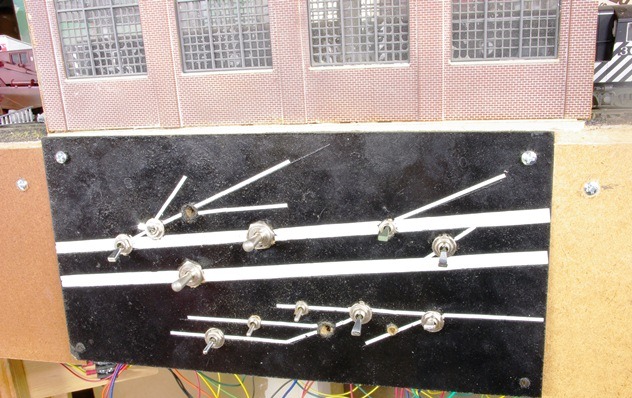
A third task is to replace the control panel toggles that operated Tortoise switch machines with stationary DCC decoders. This will do two things. The first is to allow switches to be thrown at any point on the layout via a handheld DCC controller, rather than having to go to the particular panel with the proper toggle. Here's the old way of doing things:

Neither the block toggles nor the switch toggles will remain when things are finished, though this will take some time. The second advantage will be to use the USB connection to my computer to be able to control switches via a JMRI dispatcher's panel on the computer. (This will only be really useful if I can ever find other operators for the layout.)

I'm also recycling some surplus components removed during rewiring onto the T-Track module project. In addition, I'm using stationary decoders for switches from the start with T-Track.

You can also see an Atlas snap relay, surplus in the rewiring project, that will be controlled by stationary decoder and control signals on the T-track modules.

Monday, November 21, 2016

Looking At The Walthers Mainline SD70ACe

Six-axle EMDs are uncommon in California on the BNSF, even less so in the Los Angeles area. Still, I decided to give the Walthers Mainline SD70ACe a try. These are very reasonably priced, especially for the sound version, and I found one on line for 5% off the discount price on a Veterans Day sale. Here's a shot of the loco out of the box, with couplers installed:

The details are generally good, as is the paint, although the paint doesn't include warning labels. The biggest problem is the bare cab roof:


As delivered, these locos had GPS and antenna domes on the cab roof. Here is a 2014 photo of the prototype 9372 that also shows the warning labels missing from the model's paint:


More recently, PTC antenna arrays have appeared on prototype cab roofs. These vary by railroad and also by date they were installed, and some models have these, while others don't. Here is an MTH SD70ACe that I installed aftermarket PTC antennas on the cab roof:

I'm not sure, though, if the BNSF styles of PTC array are even available as aftermarket parts.

Here is a video I made to compare the lights and sound of the Walthers SD70ACe with my MTH loco, followed by a prototype BNSF SD70ACE:

The Soundtraxx basic sound with the Walthers model doesn't seem to give a choice of horn, but both the MTH and Walthers horns seem close to what you hear in the video. I wish the ditch lights were brighter in both models. I like the fact that function F5 turns the ditch lights on and off on the Walthers model.

Tuesday, November 15, 2016

My History Modeling Signals

I've had signals on my layout ever since I started with HO. I remember being in junior high school and building a signal bridge with balsa strips, washers, and red and green grain of wheat bulbs that I controlled with a DPDTY switch. My more modern evolution begins with the start of this layout project at an earlier home in 1988. I saw an article by Gary D Petersen, "Simplified CTC Signals", in the July 1988 MR. Here is an image from part of a page in that article:


Here is a switch machine block I built following the article:

I've replaced almost all of these on my current layout, when I switched to Tortoises, but this is an example of what could be done with the earlier technology. Notice that I filled in a lot of the space around the machine with silicone calk to keep it from shaking itself out of alignment. Another problem was that the machine also eventually shook loose solder connections.

Here's a photo that includes some of the electronic gear that went under the layout:


And a photo of the very crude CTC machine under construction following the Gary Petersen MR article:

I had a fantasy when we moved to this house of having a CTC board with a dispatcher in another room, but I began to realize how much wire this would require, and I also began to realize that realistically, it's hard to put together an operating group, so I dropped it. However, my layout does have signals:

Here is the electronic equipment that controls this signal.